
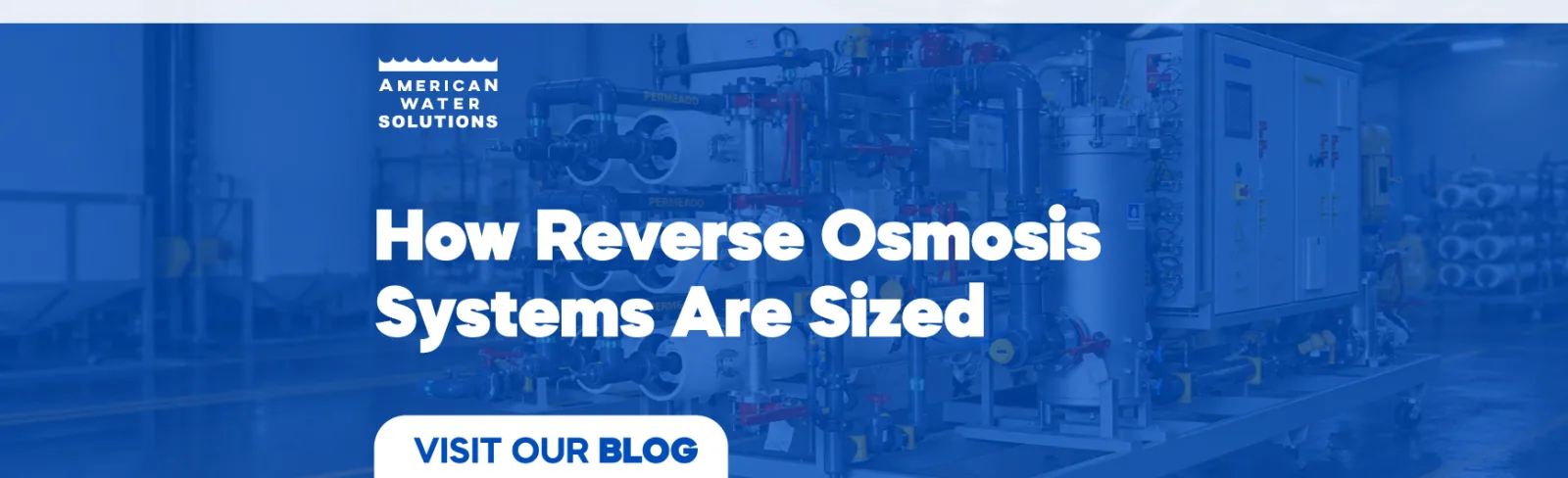
Learn the key factors behind reverse osmosis system sizing, including water demand, recovery rate, membrane flux, and feed water quality.
How Reverse Osmosis Systems Are Sized
A reverse osmosis system needs to produce the right amount of water, consistently, without overworking the membranes. Proper sizing makes that possible and helps control operating costs over the life of the system.
Water Demand
Sizing starts with how much treated water the process needs. This includes average and peak demand, operating hours, and any planned expansion.
Recovery Rate
Recovery is the percentage of feed water that becomes treated water. A higher recovery reduces water waste, but it also concentrates minerals that can form scale. The right recovery depends on the water's chemistry.
Membrane Flux
Flux is the amount of water produced per square foot of membrane. Cleaner feed water allows a higher flux, while water with more fouling potential requires a lower flux and more membrane area.
Other Key Factors
A complete design also considers:
Feed water quality and temperature
Number of membranes and pressure vessels
Arrangement of the membranes in stages
Pretreatment requirements
Colder water reduces membrane output, so systems are designed for the lowest expected temperature.
Why Proper Sizing Matters
An undersized system can't meet demand, while an oversized system increases costs. A correct design balances both and extends membrane life.
Understand the differences between buying and renting a mobile water treatment system and the factors that help you choose the right option.
Buying vs. Renting a Mobile Water Treatment System
When a project needs treated water quickly, a mobile water treatment system is often the answer. The next question is whether to rent the equipment or buy it. Both options can work, depending on the project.
When Renting Makes Sense
Renting is usually a good fit for short-term needs, such as emergencies, plant shutdowns, or pilot tests. It requires a lower upfront investment and can be useful when the water quality is still unknown.
When Buying Makes Sense
Buying is often the better choice for projects that last longer than a year or that repeat over time. A purchased system can be engineered for the specific water source and moved to future projects when the current one ends.
Factors to Consider
Before deciding, it helps to review:
How long the site will need treated water
Whether the water source or demand will change
The cost of current alternatives, such as hauling water
Who will operate and maintain the system
Whether the equipment can be reused on another project
Over a long project, rental payments continue every month, while a purchased system becomes an asset the company keeps.
The Value of a Containerized Design
Containerized systems combine treatment equipment in a single transportable unit. This makes them easier to install, relocate, and reuse.
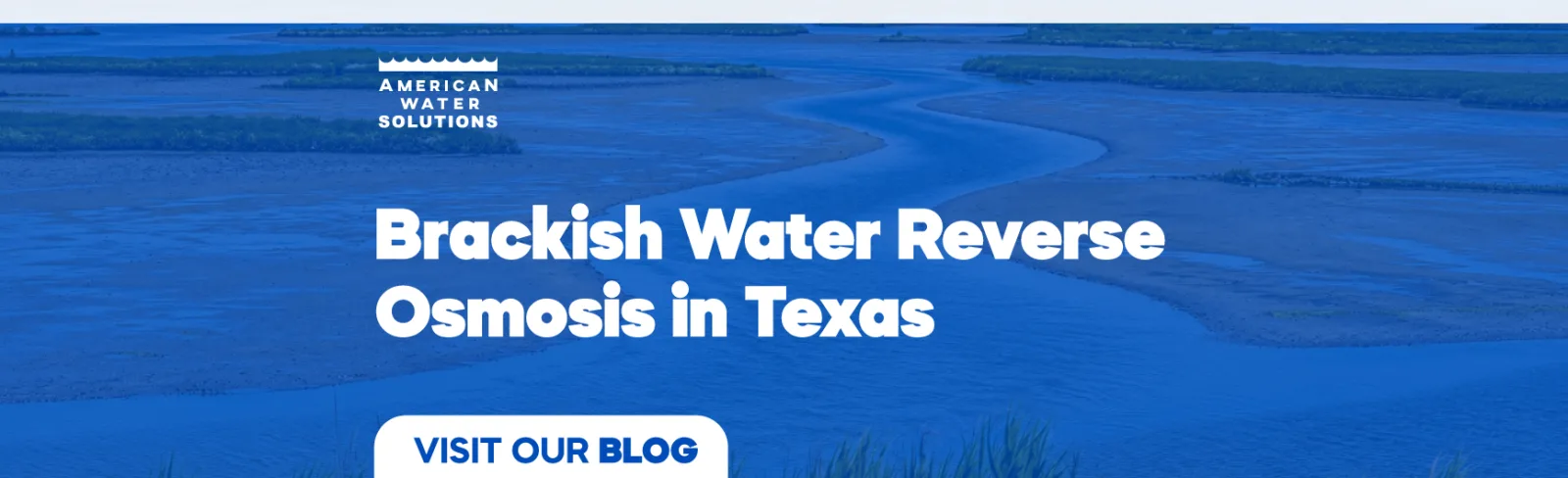
Learn what brackish groundwater is, why it matters in Texas, and how reverse osmosis turns it into usable water for industry and agriculture.
Brackish Water Reverse Osmosis in Texas
In many parts of Texas, the groundwater available to a facility or farm isn't fresh enough to use directly. It isn't seawater either. It's brackish water, and with the right treatment it can become a reliable water source.
What Is Brackish Water?
Brackish water contains more dissolved salts than fresh water but less than seawater. The Texas Water Development Board classifies groundwater with 1,000 to 9,999 mg/L of total dissolved solids (TDS) as brackish. According to the board, Texas holds more than 3.2 billion acre-feet of this water underground.
Why It Needs Treatment
The salts and minerals in brackish water can cause scale in equipment, damage sensitive crops, and affect product quality in industrial processes. Before it can be used, most of those dissolved solids need to be removed.
How Reverse Osmosis Treats Brackish Water
Reverse osmosis pushes water through a semi-permeable membrane that rejects most dissolved salts. The process produces treated water, called permeate, and a concentrate stream that carries the salts away. Because brackish water has a lower salt content than seawater, the system operates at lower pressure and uses less energy.
A successful brackish water system depends on:
A complete water analysis
Proper pretreatment to remove iron, manganese, and solids
The right recovery rate for the water's mineral content
A plan for managing the concentrate
A reliable water treatment system doesn't happen by accident.
It is the result of a structured process that connects water quality, process requirements, equipment selection, engineering, installation, and startup.
Step 1: Understand the Water
The first step is determining what is in the water.
Parameters such as TDS, hardness, pH, turbidity, iron, manganese, suspended solids, and organic content can influence technology selection.
Step 2: Define the Process Requirements
Water quality is only part of the equation.
Engineers also need to understand required flow, operating hours, intended water use, available space, and desired treated-water quality.
Step 3: Select the Treatment Technologies
Once the requirements are understood, the appropriate technologies can be evaluated.
Depending on the project, the treatment train may include pretreatment, Ultrafiltration, Microfiltration, Nanofiltration, Reverse Osmosis, desalination, ion exchange, or other solutions.
Step 4: Engineer the System
Equipment must be properly sized and integrated.
Pumps, membranes, filtration equipment, controls, instrumentation, tanks, and other components need to work together as one system.
Step 5: Installation and Startup
The final stages involve installing the equipment, commissioning the system, and verifying that the treatment process operates according to the project's requirements.
American Water Solutions states that it designs, manufactures, installs, and starts up water treatment plants for human consumption and industrial processes.
A successful project isn't just about choosing equipment. It's about connecting every stage of the process.
Advanced treatment technologies depend on good feedwater conditions.
Before water reaches membranes, pumps, or other sensitive equipment, contaminants may need to be reduced through pretreatment.
What Does Pretreatment Do?
Pretreatment prepares incoming water for the main treatment process.
Depending on water quality, it may include:
Multimedia filtration
Activated carbon
Water softening
Chemical dosing
Other filtration technologies
The goal is to reduce contaminants that could interfere with downstream treatment.
Protecting Membranes
Suspended solids, hardness, chlorine, organic matter, and other contaminants can affect membrane performance.
Appropriate pretreatment can reduce fouling and scaling risks while helping maintain more stable operating conditions.
More Than Membrane Protection
Pretreatment also helps protect pumps, valves, piping, and other components.
A properly designed treatment train can reduce unnecessary stress throughout the system and contribute to more reliable operation.
One Configuration Does Not Fit All
Pretreatment requirements depend on the source water.
Groundwater, surface water, municipal water, seawater, and other sources can have very different characteristics.
American Water Solutions offers pretreatment solutions including multimedia filters, activated carbon, and softeners, integrated according to project requirements.
A strong treatment system starts before the main treatment technology.
Water treatment performance isn't measured only by how much treated water a system produces.
Another important factor is water recovery—the percentage of feedwater converted into usable treated water.
What Is Water Recovery?
Recovery represents the portion of incoming water that becomes treated product water.
The remaining water may leave the system as concentrate, reject, or wastewater depending on the treatment technology.
A higher recovery rate can reduce water losses, but the optimal recovery depends on water chemistry, membrane limitations, scaling potential, and system design.
Why Recovery Matters
Improving recovery can help facilities make better use of their available water supply.
It may also reduce the volume of concentrate requiring management and contribute to more efficient resource utilization.
However, simply increasing recovery without considering water chemistry can create operational challenges.
Recovery Requires Balance
High recovery must be supported by appropriate pretreatment, membrane selection, monitoring, and operating conditions.
Scaling and fouling risks can increase when systems are pushed beyond appropriate operating limits.
This is why recovery should be optimized—not maximized blindly.
Engineering for Efficiency
American Water Solutions identifies maximum recovery, lower energy consumption, and process stability as important objectives in its system development approach.
The optimal recovery target should always be determined according to the specific application and feedwater conditions.
Better recovery isn't simply about using less water. It's about using water more intelligently.
Dissolved minerals and ions can create significant challenges in industrial water systems.
When applications require water with reduced ionic content, ion exchange demineralization can provide an effective treatment option.
What Is Ion Exchange?
Ion exchange uses specialized resins to exchange unwanted ions in water with ions held within the resin.
Through this process, dissolved ionic contaminants can be reduced to achieve the water quality required for specific applications.
Why Demineralization Matters
Dissolved minerals can affect industrial processes, equipment performance, and water quality.
In applications requiring highly controlled water chemistry, reducing ionic content can help support more consistent process conditions.
The required level of demineralization depends on the final application and water quality specifications.
Ion Exchange vs. Membrane Technologies
Ion exchange and membrane technologies solve different treatment challenges.
Reverse Osmosis is widely used for reducing dissolved salts and producing high-quality water, while ion exchange can provide additional demineralization when specific water chemistry requirements must be achieved.
In some applications, these technologies can complement one another.
Designing the Right System
The correct technology depends on the water analysis and treatment objective.
American Water Solutions includes demineralization by ion exchange among its water treatment capabilities and designs systems according to application requirements.
When water chemistry matters, treatment should be designed around the ions—not just the water itself.
Before water reaches advanced treatment equipment, removing larger contaminants can make a significant difference.
Microfiltration is a membrane-based process designed to reduce suspended particles and other contaminants that can affect downstream treatment.
How Microfiltration Works
Microfiltration uses membranes with relatively large pores compared with technologies such as Ultrafiltration and Reverse Osmosis.
Water passes through the membrane while suspended particles and other larger contaminants are retained.
This makes microfiltration useful when the primary goal is improving water clarity and reducing particulate matter.
Why It Matters in Industrial Applications
Suspended solids can create problems throughout a water treatment system.
Particles may contribute to fouling, increase maintenance requirements, and affect the performance of pumps, valves, and downstream membranes.
By removing these contaminants earlier in the process, microfiltration can help create better feedwater conditions for subsequent treatment stages.
Microfiltration as Part of a Treatment Train
Industrial water treatment rarely depends on a single technology.
A complete system may combine filtration, chemical treatment, membrane processes, disinfection, and other technologies depending on the application.
For example, microfiltration may be integrated with additional membrane technologies when the water requires progressively higher levels of purification.
Designed Around the Application
The best treatment configuration depends on water quality, flow requirements, and final water use.
American Water Solutions provides multiple treatment technologies, including Microfiltration, Ultrafiltration, Nanofiltration, Reverse Osmosis, and specialized pretreatment systems.
Effective water treatment begins by removing the right contaminants at the right stage.
Not every water treatment application requires the same level of purification.
In some cases, Reverse Osmosis may provide more treatment than necessary, while conventional filtration may not remove enough dissolved contaminants. This is where Nanofiltration (NF) can become an effective option.
What Is Nanofiltration?
Nanofiltration is a membrane-based water treatment technology positioned between Ultrafiltration and Reverse Osmosis in terms of filtration capability.
Its membranes allow water to pass through while reducing certain dissolved contaminants and organic compounds.
The technology can be useful when a facility needs selective treatment without requiring complete demineralization.
Where Can Nanofiltration Be Used?
NF systems can be considered for applications where water contains specific dissolved contaminants that need to be reduced.
Depending on feedwater characteristics and treatment objectives, nanofiltration may be integrated into industrial processes, pretreatment strategies, and water purification applications.
The appropriate configuration depends on the chemistry of the source water and the quality required after treatment.
NF vs. Reverse Osmosis
Reverse Osmosis provides a higher level of dissolved-solids removal and is commonly selected for applications requiring high-purity water or desalination.
Nanofiltration can be considered when the treatment objective is more selective.
Choosing between NF and RO should therefore be based on actual water quality and process requirements rather than simply selecting the technology with the highest filtration capability.
Why System Design Matters
Membrane technology is only one part of the solution.
Pretreatment, pressure, recovery, membrane selection, monitoring, and system configuration all influence performance.
American Water Solutions develops water treatment systems using technologies including Nanofiltration, Ultrafiltration, Reverse Osmosis, and pretreatment, according to project requirements.
The right membrane technology starts with understanding what your water actually needs.
Every water treatment project starts with the same challenge: selecting the right technology for the water being treated.
A system designed for well water may not be suitable for seawater, while a solution for municipal water may require significant modifications when treating surface water or wastewater.
Understanding the water source is therefore one of the most important steps in designing an efficient treatment system.
Why Water Source Matters
Water can contain different levels of dissolved solids, hardness, iron, manganese, suspended solids, organic matter, and microbiological contaminants depending on its origin.
These characteristics directly influence equipment selection, pretreatment requirements, membrane configuration, and operating conditions.
For example, seawater requires specialized desalination technology, while water with high suspended solids may require additional filtration before reaching a membrane system.
Matching Technology to Water Quality
Different technologies address different treatment challenges.
Microfiltration and Ultrafiltration can help remove suspended particles and microorganisms. Nanofiltration can provide selective removal of certain dissolved contaminants, while Reverse Osmosis is widely used when significant reduction of dissolved salts is required.
Pretreatment technologies such as multimedia filtration, activated carbon, and softening can also be integrated to protect downstream equipment.
Why Customized Design Matters
There is no universal water treatment system.
The appropriate solution depends on the source water, required flow, final water quality, operating conditions, and intended application.
At American Water Solutions, systems are engineered according to each project's requirements, combining different treatment technologies when necessary to achieve reliable performance and efficient operation.
A Better Starting Point
The right technology begins with the right information.
Water analysis and process requirements provide the foundation for selecting equipment that can deliver consistent results while avoiding unnecessary complexity.
The best water treatment system isn't simply the most advanced one—it's the one designed for your water.



American Water Solutions, LLC is a Texas-based company specializing in reverse osmosis water treatment systems for residential, commercial, and industrial applications.




