
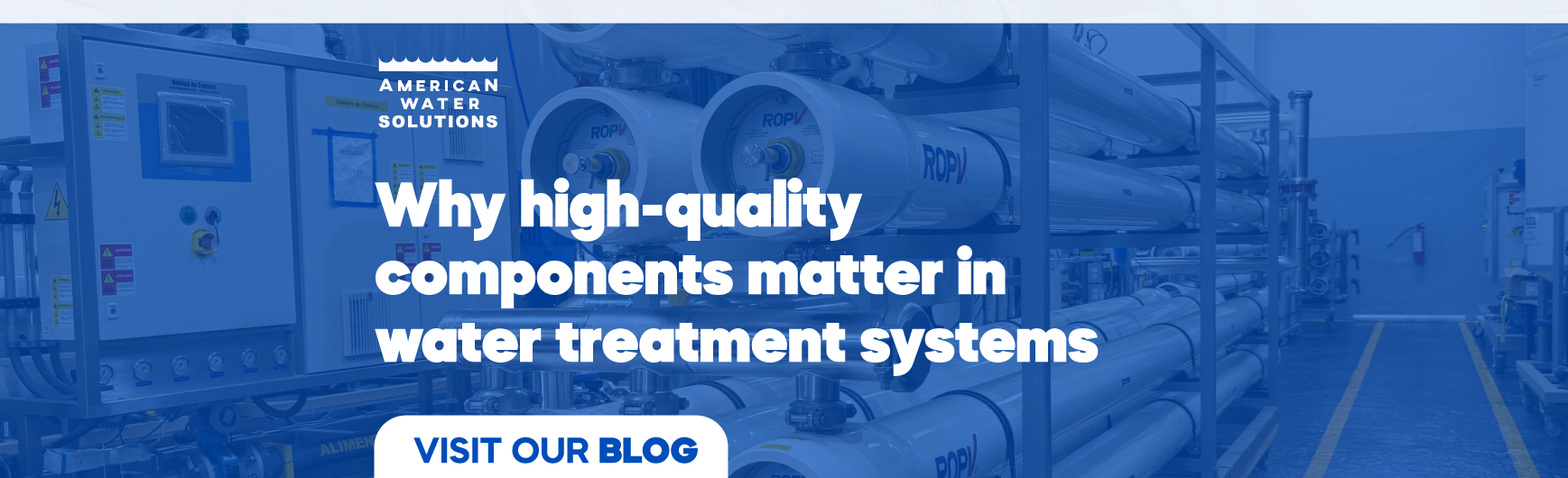
A water treatment system is only as reliable as the components that support it.
Membranes, pumps, filters, pressure vessels, valves, instrumentation, and controls must work together under demanding operating conditions. Choosing high-quality components can improve reliability and reduce long-term maintenance risks.
Reliable Components Support Consistent Performance
Industrial water treatment systems often operate for extended periods. Components must maintain performance despite pressure changes, chemical exposure, temperature variations, and continuous use.
Quality equipment helps support stable operation and predictable results.
Lower Maintenance Requirements
Low-quality components may require more frequent replacement or adjustment. This can increase maintenance costs and create additional downtime.
Durable components may provide a higher initial value by reducing replacement frequency and supporting longer service life.
Better Integration
System performance depends on how components work together.
Pumps must provide appropriate pressure, membranes must match feedwater conditions, and controls must accurately monitor the process.
Selecting compatible components helps improve efficiency and reduce operational issues.
Quality Is Part of System Design
American Water Solutions works with recognized brands across pumps, filtration, membranes, control, and water treatment technologies. The goal is to integrate reliable components into systems designed for specific applications.
Unexpected downtime can affect production schedules, increase maintenance costs, and create operational uncertainty.
In many cases, system failures are not caused by a single event. They develop gradually through declining performance, worn components, inadequate pretreatment, or delayed maintenance.
Reducing downtime requires a proactive approach.
Monitor Performance Trends
Changes in pressure, flow, conductivity, or water production may indicate an emerging problem.
Tracking these values over time can help operators identify performance changes before they result in system failure.
Protect Critical Components
Membranes, pumps, filters, valves, and instrumentation should operate within their intended conditions.
Proper pretreatment and routine inspections help reduce unnecessary stress and extend equipment life.
Maintain Critical Spare Parts
Waiting for replacement components after a failure can extend downtime.
Facilities should evaluate which parts are essential for continuous operation and maintain appropriate inventory when practical.
Plan Maintenance Strategically
Preventive maintenance can often be scheduled during planned production interruptions.
This reduces the risk of emergency repairs and allows maintenance teams to address issues before they become critical.
Design for Reliability
System design also affects downtime. Accessible components, clear instrumentation, and properly sized equipment can simplify maintenance and improve operational response.
Modern water treatment systems generate valuable information every second. Pressure, flow, conductivity, tank levels, pump status, and water quality can all influence system performance.
Automation helps transform this information into faster and more consistent operational decisions.
Consistent Process Control
Manual operation may lead to variations in system performance. Automated controls help maintain operating conditions within defined limits.
This can support stable water production and reduce the risk of errors caused by delayed adjustments.
Faster Response to Changing Conditions
Water quality can change over time. Automated systems can detect variations and respond according to programmed operating parameters.
This may include adjusting pumps, controlling valves, activating alarms, or protecting equipment when conditions move outside acceptable limits.
Improved Equipment Protection
Automation can help prevent equipment from operating under unsafe conditions.
Low-pressure protection, high-pressure alarms, tank level controls, and automatic shutdown sequences can reduce the risk of damage.
Simplified Operation
Automation does not replace skilled operators. Instead, it provides better visibility and reduces the need for constant manual adjustments.
Operators can focus on system performance, preventive maintenance, and process optimization.
Building Smarter Water Systems
At American Water Solutions, control and instrumentation can be integrated according to project requirements. Automated solutions help support efficient operation and reliable system performance.
How Desalination Supports Industrial Growth in Water-Stressed Regions
Water availability is becoming an increasingly important factor in industrial development. In coastal regions and areas affected by drought, limited freshwater supplies can restrict production and increase operational risk.
Desalination provides an alternative source by converting seawater or brackish water into high-quality water suitable for industrial, commercial, and other applications.
Turning Alternative Sources into Reliable Supply
Seawater contains high concentrations of dissolved salts, making it unsuitable for many industrial processes without treatment.
Seawater Reverse Osmosis uses high-pressure pumps and specialized membranes to separate freshwater from dissolved salts and other contaminants.
The result is treated water that can support industrial operations where conventional freshwater supplies are limited.
Supporting Operational Continuity
Dependence on a single water source can create vulnerability. Supply restrictions, drought, infrastructure failures, or increased demand may affect water availability.
Desalination can improve water security by providing access to an alternative source.
Modern Desalination Is More Efficient
Advances in membrane technology, energy recovery, automation, and system design continue to improve desalination performance.
Modern systems can be engineered to balance water production, energy consumption, recovery, and long-term operating costs.
Custom Solutions for Complex Applications
Water quality and production requirements vary by location and industry. Desalination systems must be designed according to feedwater conditions and the intended use of the treated water.
American Water Solutions develops water treatment solutions tailored to project requirements, including systems for challenging water sources.

Industrial equipment depends on clean, consistent water to operate efficiently. Suspended solids, sediment, corrosion particles, and other contaminants can gradually affect pumps, valves, membranes, heat exchangers, and process equipment.
Industrial filtration provides an important line of defense by removing these contaminants before they create operational problems.
Protecting Pumps and Valves
Particles in untreated water can cause abrasion and wear inside pumps and valves. Over time, this may reduce efficiency, increase maintenance requirements, and shorten equipment lifespan.
Proper filtration helps reduce the amount of abrasive material entering critical components.
Supporting Membrane Performance
Reverse Osmosis and Ultrafiltration membranes are designed to treat water at a high level, but excessive suspended solids can cause fouling and reduce performance.
Cartridge filters, multimedia filtration, and other pretreatment technologies help protect membranes and support stable operation.
Improving Process Reliability
Filtration helps maintain more consistent water quality. This is especially important in industrial processes where water quality affects production, product consistency, or equipment performance.
Cleaner water can reduce unexpected interruptions and support more reliable operation.
Selecting the Right Filter
Filter selection depends on particle size, flow rate, water quality, operating pressure, and application requirements.
No single filtration solution is ideal for every process. The correct design should balance contaminant removal with pressure loss, maintenance needs, and operating efficiency.

Every successful water treatment project begins with one important question: What is in the water?
Water quality can vary significantly depending on whether the source is a well, municipal supply, river, lake, wastewater stream, or seawater. Designing a system without understanding these characteristics can lead to poor performance, unnecessary maintenance, and higher operating costs.
A complete water analysis provides the information needed to select the right treatment technologies.
What Should Be Evaluated?
A water analysis may include parameters such as pH, Total Dissolved Solids (TDS), hardness, alkalinity, iron, manganese, turbidity, suspended solids, organic content, and microbiological activity.
Each parameter can influence system design.
For example, high hardness may increase scaling risk, while elevated iron or manganese can cause fouling and discoloration. High organic content may require additional pretreatment, and elevated salinity may determine whether Reverse Osmosis or another technology is necessary.
Why One Solution Does Not Fit Every Application
A treatment system that performs well with municipal water may not be suitable for groundwater or surface water.
Different sources require different treatment strategies. The correct solution depends not only on water quality but also on the intended use of the treated water.
Water used for cooling, manufacturing, drinking, boiler feed, or food processing may require different treatment levels.
Better Data Leads to Better Performance
Water analysis helps engineers determine the appropriate filtration stages, membrane configuration, chemical treatment, operating pressure, and recovery targets.
It also helps prevent overdesign. Installing unnecessary equipment can increase costs without improving performance.
A Customized Approach
American Water Solutions develops treatment solutions based on application requirements and water characteristics. This approach supports efficient system design and helps improve long-term reliability.

The cost of a water treatment system extends far beyond the initial purchase. Energy consumption, maintenance requirements, equipment lifespan, chemical use, and system downtime can all influence the total cost of ownership.
A properly engineered system considers these factors from the beginning. Rather than focusing only on initial equipment costs, effective system design prioritizes long-term efficiency and operational reliability.
The Importance of Proper Sizing
An undersized system may struggle to meet production demands, while an oversized system can consume unnecessary energy and increase capital costs.
Proper sizing begins with understanding the required flow rate, operating schedule, water source, and final water quality. When these factors are accurately evaluated, the system can operate closer to its intended performance range.
Energy Efficiency Starts with Design
Pumps, membranes, controls, and operating pressure all affect energy consumption.
A system designed with efficient components and optimized operating conditions can reduce unnecessary power use while maintaining stable water production. Over time, even small efficiency improvements may create significant savings.
Better Design Can Reduce Maintenance
Maintenance requirements are often influenced by the quality of the incoming water and the way treatment stages are integrated.
Effective pretreatment can protect membranes, pumps, valves, and downstream equipment. Proper instrumentation also helps operators identify changes before they become major failures.
Custom Engineering Creates Value
Every facility has different water conditions and process requirements. A standard system may not provide the best balance between performance and operating cost.
Custom-engineered systems can be configured according to water quality, production goals, available space, and operational needs.
At American Water Solutions, systems are designed to meet specific application requirements while supporting reliable performance and long-term efficiency.

Choosing the right water treatment technology is essential for achieving reliable water quality, efficient operation, and long-term cost control. Two of the most widely used technologies are Reverse Osmosis (RO) and Ultrafiltration (UF). While both use membrane-based filtration, they are designed to solve different water treatment challenges.
Understanding how these technologies work can help facilities select a solution that matches their water source, production requirements, and desired water quality.
What Is Ultrafiltration?
Ultrafiltration uses membranes with extremely small pores to remove suspended solids, turbidity, bacteria, viruses, and colloidal particles. It is highly effective for improving water clarity and reducing microbiological contaminants.
However, UF does not significantly remove dissolved salts or reduce Total Dissolved Solids (TDS). This makes it an excellent choice for applications that require clean, clarified water while retaining naturally dissolved minerals.
Ultrafiltration is commonly used in industrial pretreatment, food and beverage production, water reuse, and applications where consistent water quality is essential.
What Is Reverse Osmosis?
Reverse Osmosis uses pressure to force water through a semipermeable membrane. The membrane separates water from a wide range of dissolved contaminants, including salts, minerals, metals, and other impurities.
Because RO provides a higher level of purification, it is commonly used for high-purity process water, boiler feedwater, desalination, drinking water production, and industrial applications with strict water quality requirements.
The Main Difference
The primary difference is the type of contaminants each technology removes.
Ultrafiltration focuses mainly on suspended particles and microorganisms. Reverse Osmosis also targets dissolved salts and smaller contaminants that pass through UF membranes.
In many industrial systems, both technologies work together. UF may be used as a pretreatment stage to protect RO membranes and improve overall system performance.
Choosing the Right Solution
The right technology depends on several factors, including the water source, contaminant levels, required flow rate, final water quality, and operating conditions.
At American Water Solutions, water treatment systems are designed around each application. By evaluating the complete process, facilities can select a solution that delivers reliable performance without adding unnecessary complexity.

As industries continue to grow, so does the need for water treatment solutions that are flexible, reliable, and easy to deploy. Traditional treatment plants often require extensive construction, long installation timelines, and significant infrastructure investment. For many businesses, these challenges can delay operations and increase project costs.
Containerized water treatment systems offer a modern alternative. By integrating advanced treatment technologies into a compact, transportable unit, these systems provide an efficient solution for facilities that need high-quality water treatment with greater flexibility.
What Are Containerized Water Treatment Systems?
A containerized water treatment system is a fully integrated treatment plant built inside a standard shipping container or modular enclosure. Depending on the application, these systems can include technologies such as Reverse Osmosis (RO), Ultrafiltration (UF), Nanofiltration (NF), pretreatment equipment, pumps, control panels, and automated monitoring systems.
Because the entire system is assembled and tested before shipment, installation on-site is faster and significantly less complex than building a conventional treatment facility.
Key Benefits for Industrial Operations
One of the greatest advantages of containerized systems is their ability to reduce installation time. Since the equipment arrives pre-engineered and ready for connection, facilities can begin operating much sooner than with traditional water treatment plants.
Their modular design also makes them highly adaptable. As production demands grow, additional units can often be added without redesigning the entire system, providing a scalable solution that supports future expansion.
Containerized systems are also ideal for locations where available space is limited. Their compact footprint allows companies to maximize treatment capacity while minimizing the need for large infrastructure projects.
Where Are They Used?
Containerized water treatment systems are used across a wide range of industries that require dependable water treatment in challenging environments.
They are commonly installed at manufacturing facilities, mining operations, oil and gas sites, food and beverage plants, power generation facilities, and remote industrial locations where permanent infrastructure may not be practical.
Their portability also makes them an excellent solution for temporary projects, emergency response, and operations that may need to relocate over time.
Engineered for Performance
At American Water Solutions, containerized water treatment systems are custom-engineered to meet the specific needs of each customer. By combining advanced treatment technologies with premium-quality components and intelligent automation, every system is designed to deliver reliable performance, maximize water recovery, and reduce operating costs.
This approach ensures that customers receive a solution tailored to their process requirements while maintaining long-term efficiency and operational reliability.

Water plays a critical role in nearly every industrial process, yet its quality is often overlooked until problems begin to affect production. Poor water quality doesn't just impact equipment—it can increase operating costs, reduce efficiency, and interrupt day-to-day operations.
Contaminants such as dissolved minerals, suspended solids, bacteria, and other impurities can gradually reduce system performance. Without proper treatment, these issues often lead to higher maintenance expenses, unexpected downtime, and shorter equipment lifespan.
Understanding the true cost of poor water quality is the first step toward protecting your operation and improving long-term performance.
Increased Operating Costs
When untreated or poorly treated water enters an industrial system, equipment must work harder to maintain production. Mineral deposits, scaling, and fouling reduce efficiency, causing pumps, boilers, cooling systems, and membranes to consume more energy.
As energy usage increases, so do operating expenses. At the same time, maintenance requirements become more frequent, creating additional labor costs and reducing overall productivity.
Investing in proper water treatment helps prevent these hidden expenses before they affect your bottom line.
Equipment Damage and Unplanned Downtime
Poor water quality can significantly shorten the lifespan of industrial equipment. Scaling inside pipes and heat exchangers reduces heat transfer, while corrosion can weaken critical components over time. Reverse osmosis membranes may also foul more quickly, reducing water production and increasing cleaning requirements.
If these problems are not addressed early, they can lead to unexpected equipment failures and costly production interruptions.
Preventive water treatment helps protect valuable assets, minimize downtime, and maintain consistent system performance.
Product Quality and Process Reliability
For many industries, water is more than a utility—it's a key part of the manufacturing process. Sectors such as food and beverage, pharmaceuticals, electronics, and power generation depend on stable water quality to ensure consistent production.
Variations in water quality can affect product performance, reduce process efficiency, and create compliance challenges. Maintaining high-quality treated water helps improve reliability while supporting quality control throughout the production process.
Investing in Better Water Treatment
Advanced technologies such as Reverse Osmosis, Ultrafiltration, and Pretreatment systems are designed to remove contaminants before they impact industrial operations.
At American Water Solutions, every system is custom-engineered to meet each customer's specific process requirements. By combining advanced treatment technologies with premium components and intelligent system design, businesses can improve water quality, reduce operating costs, and extend equipment life.
Choosing the right water treatment solution isn't simply about producing cleaner water—it's about improving the performance of your entire operation.



American Water Solutions, LLC is a Texas-based company specializing in reverse osmosis water treatment systems for residential, commercial, and industrial applications.




