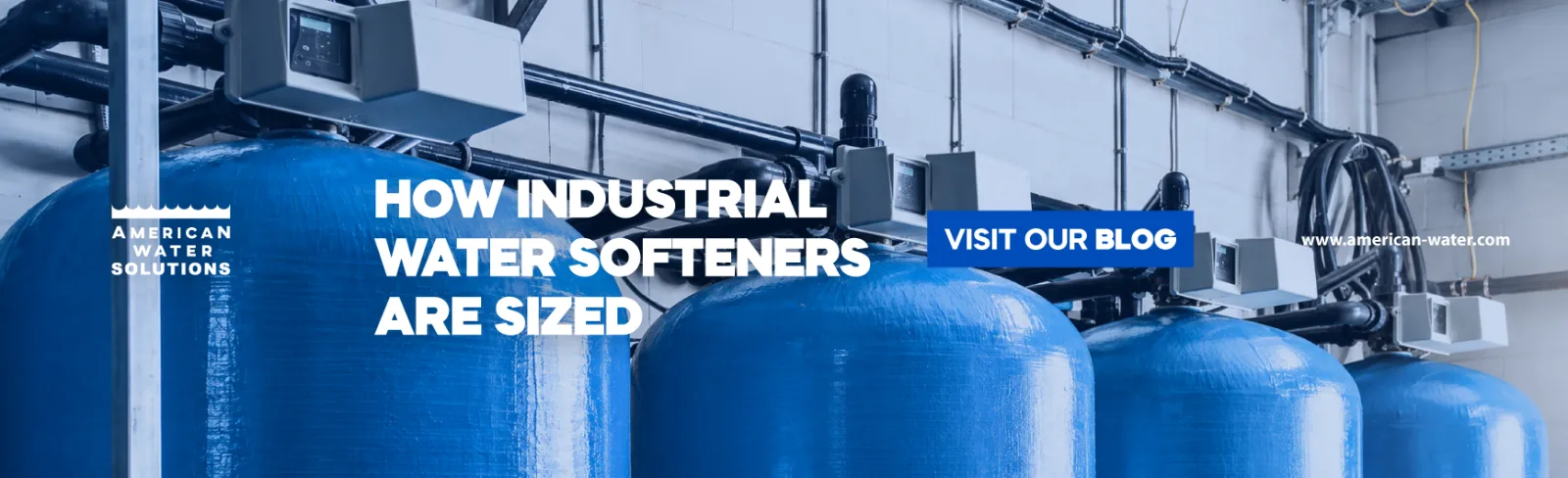
Hard water can leave scale in boilers, heat exchangers, and reverse osmosis membranes. An industrial water softener prevents this, but only when it's sized correctly for the water and the operation.
Water Hardness
Sizing starts with knowing how much calcium and magnesium the water contains. Hardness is often reported in mg/L and converted to grains per gallon by dividing by 17.1.
Daily Water Use
The amount of water the facility uses each day, including peak days, determines the total hardness the softener must remove. Multiplying hardness by daily water use gives the daily hardness load.
Resin Capacity
Softening resin can remove a limited amount of hardness before it needs regeneration with salt. Its capacity depends on the amount of salt used. Lower salt doses use salt more efficiently, while higher doses increase capacity.
Choosing the Right Configuration
Common options include:
Single tank systems, for operations that can pause during regeneration
Twin alternating systems, which keep one tank in service while the other regenerates
Multi-tank systems, for high or variable flow rates
For continuous operations, twin alternating systems with metered regeneration help provide soft water at all times while reducing salt and water use.
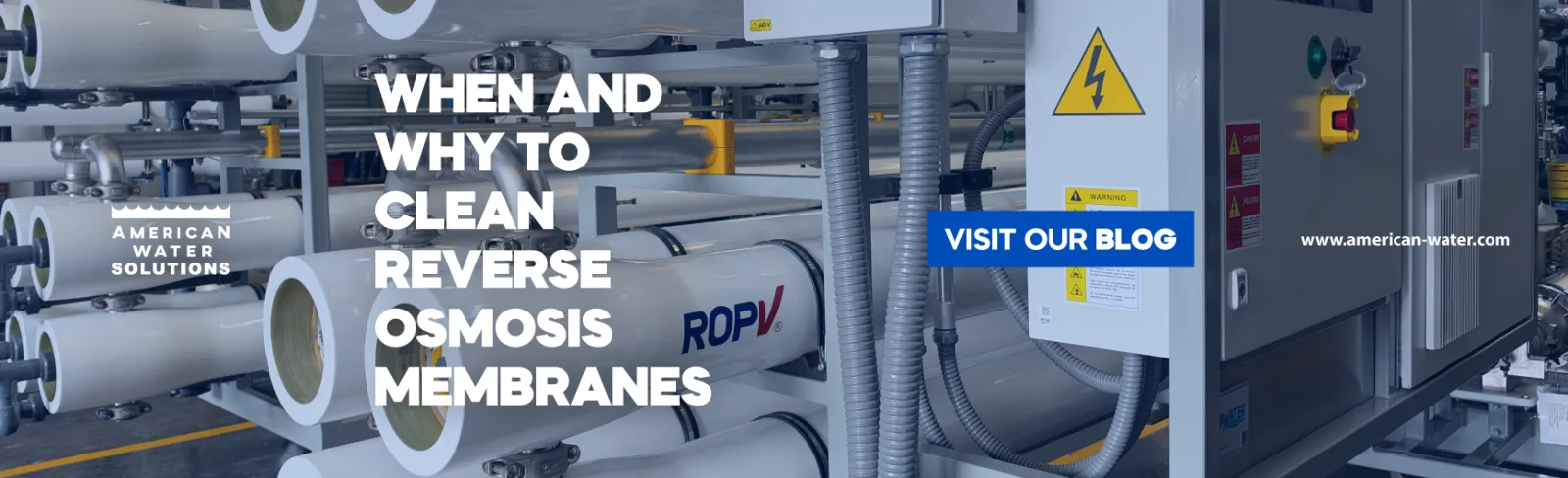
Even with good pretreatment, reverse osmosis membranes gradually collect deposits. Cleaning them at the right time helps restore performance and extend their service life.
Signs That Membranes Need Cleaning
Membrane manufacturers generally recommend cleaning when one of these changes appears compared to normal operation:
Water production drops 10% to 15%
Salt passage increases 5% to 10%
Pressure differential rises 10% to 15%
These values should be compared using normalized data, which accounts for changes in temperature and pressure.
Types of Membrane Cleaners
The right cleaner depends on what is fouling the membrane. High-pH cleaners remove organic matter, biofilm, and silt. Low-pH cleaners remove mineral scale and metals such as iron.
Why Timing Matters
Waiting too long makes deposits harder to remove and can permanently reduce membrane performance. Cleaning too often, on the other hand, may point to a pretreatment problem that should be corrected.
A Controlled Process
Membrane cleaning is typically done through a clean-in-place system that circulates the cleaning solution through the membranes at controlled flow, pH, and temperature, following the manufacturer's limits.
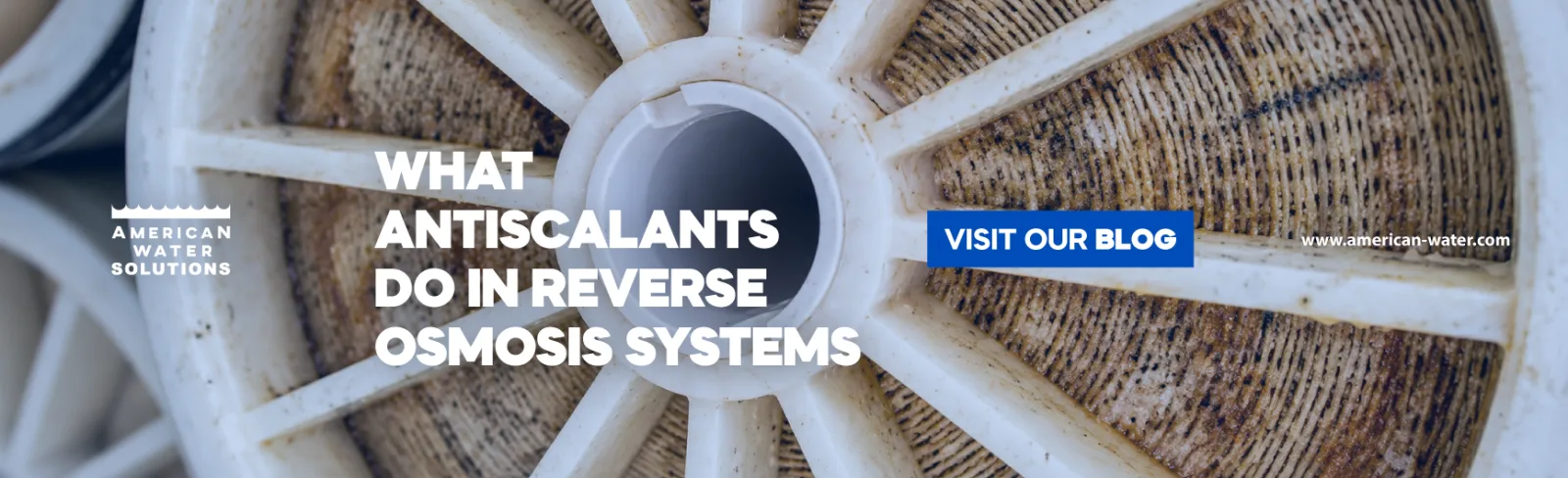
Learn how antiscalants prevent mineral scale on reverse osmosis membranes, which minerals cause problems, and why correct dosing matters.
What Antiscalants Do in Reverse Osmosis Systems
As a reverse osmosis system produces treated water, the minerals left behind become more concentrated. Without protection, they can form scale on the membranes. Antiscalants help prevent that problem.
Why Scale Forms
The higher the recovery of a reverse osmosis system, the more concentrated the minerals become in the reject stream. At 75% recovery, that stream carries about four times the minerals of the feed water. When a mineral exceeds its solubility limit, it can deposit on the membrane surface.
Common Scale-Forming Minerals
Calcium carbonate
Calcium sulfate
Barium and strontium sulfate
Silica
Some of these, like silica and barium sulfate, are especially difficult to remove once they form.
How Antiscalants Work
Antiscalants are specialty chemicals that delay crystal formation and keep crystals from sticking to the membrane. This allows the concentrated water to leave the system before scale can develop.
Why Correct Dosing Matters
The right product and dose depend on the water analysis, the recovery rate, and the water temperature. Too little antiscalant allows scale to form, while too much can contribute to fouling. Antiscalants are usually injected before the cartridge filters with a dosing pump, so they mix completely before reaching the membranes.
Learn what the silt density index measures, why it matters for reverse osmosis membranes, and how pretreatment helps keep it under control.
What Is the Silt Density Index (SDI)?
Reverse osmosis membranes are sensitive to fine particles in the feed water. The silt density index, or SDI, is one of the most important measurements for understanding that risk.
What SDI Measures
SDI indicates how quickly suspended particles and colloids plug a fine 0.45-micron filter under controlled conditions. The test follows the ASTM D4189 standard method and gives a number that reflects the water's fouling potential.
Why It Matters for Reverse Osmosis
Water with a high SDI can deposit particles on the membrane surface. Over time, this reduces water production, increases pressure, and leads to more frequent cleanings. Membrane manufacturers generally recommend an SDI below 3, and most require it to stay below 5.
SDI vs. Turbidity
Turbidity measures how cloudy water looks. SDI measures how the water actually behaves against a filter surface, which makes it a better indicator of membrane fouling.
How to Keep SDI Under Control
When SDI is high, the solution is usually improving pretreatment. Common options include:
Multimedia filtration
Coagulation for fine particles
Cartridge filtration
Ultrafiltration
Regular SDI testing helps confirm that pretreatment is working, especially when the water source changes.
Learn the key factors behind reverse osmosis system sizing, including water demand, recovery rate, membrane flux, and feed water quality.
How Reverse Osmosis Systems Are Sized
A reverse osmosis system needs to produce the right amount of water, consistently, without overworking the membranes. Proper sizing makes that possible and helps control operating costs over the life of the system.
Water Demand
Sizing starts with how much treated water the process needs. This includes average and peak demand, operating hours, and any planned expansion.
Recovery Rate
Recovery is the percentage of feed water that becomes treated water. A higher recovery reduces water waste, but it also concentrates minerals that can form scale. The right recovery depends on the water's chemistry.
Membrane Flux
Flux is the amount of water produced per square foot of membrane. Cleaner feed water allows a higher flux, while water with more fouling potential requires a lower flux and more membrane area.
Other Key Factors
A complete design also considers:
Feed water quality and temperature
Number of membranes and pressure vessels
Arrangement of the membranes in stages
Pretreatment requirements
Colder water reduces membrane output, so systems are designed for the lowest expected temperature.
Why Proper Sizing Matters
An undersized system can't meet demand, while an oversized system increases costs. A correct design balances both and extends membrane life.
Understand the differences between buying and renting a mobile water treatment system and the factors that help you choose the right option.
Buying vs. Renting a Mobile Water Treatment System
When a project needs treated water quickly, a mobile water treatment system is often the answer. The next question is whether to rent the equipment or buy it. Both options can work, depending on the project.
When Renting Makes Sense
Renting is usually a good fit for short-term needs, such as emergencies, plant shutdowns, or pilot tests. It requires a lower upfront investment and can be useful when the water quality is still unknown.
When Buying Makes Sense
Buying is often the better choice for projects that last longer than a year or that repeat over time. A purchased system can be engineered for the specific water source and moved to future projects when the current one ends.
Factors to Consider
Before deciding, it helps to review:
How long the site will need treated water
Whether the water source or demand will change
The cost of current alternatives, such as hauling water
Who will operate and maintain the system
Whether the equipment can be reused on another project
Over a long project, rental payments continue every month, while a purchased system becomes an asset the company keeps.
The Value of a Containerized Design
Containerized systems combine treatment equipment in a single transportable unit. This makes them easier to install, relocate, and reuse.
Learn what brackish groundwater is, why it matters in Texas, and how reverse osmosis turns it into usable water for industry and agriculture.
Brackish Water Reverse Osmosis in Texas
In many parts of Texas, the groundwater available to a facility or farm isn't fresh enough to use directly. It isn't seawater either. It's brackish water, and with the right treatment it can become a reliable water source.
What Is Brackish Water?
Brackish water contains more dissolved salts than fresh water but less than seawater. The Texas Water Development Board classifies groundwater with 1,000 to 9,999 mg/L of total dissolved solids (TDS) as brackish. According to the board, Texas holds more than 3.2 billion acre-feet of this water underground.
Why It Needs Treatment
The salts and minerals in brackish water can cause scale in equipment, damage sensitive crops, and affect product quality in industrial processes. Before it can be used, most of those dissolved solids need to be removed.
How Reverse Osmosis Treats Brackish Water
Reverse osmosis pushes water through a semi-permeable membrane that rejects most dissolved salts. The process produces treated water, called permeate, and a concentrate stream that carries the salts away. Because brackish water has a lower salt content than seawater, the system operates at lower pressure and uses less energy.
A successful brackish water system depends on:
A complete water analysis
Proper pretreatment to remove iron, manganese, and solids
The right recovery rate for the water's mineral content
A plan for managing the concentrate
A reliable water treatment system doesn't happen by accident.
It is the result of a structured process that connects water quality, process requirements, equipment selection, engineering, installation, and startup.
Step 1: Understand the Water
The first step is determining what is in the water.
Parameters such as TDS, hardness, pH, turbidity, iron, manganese, suspended solids, and organic content can influence technology selection.
Step 2: Define the Process Requirements
Water quality is only part of the equation.
Engineers also need to understand required flow, operating hours, intended water use, available space, and desired treated-water quality.
Step 3: Select the Treatment Technologies
Once the requirements are understood, the appropriate technologies can be evaluated.
Depending on the project, the treatment train may include pretreatment, Ultrafiltration, Microfiltration, Nanofiltration, Reverse Osmosis, desalination, ion exchange, or other solutions.
Step 4: Engineer the System
Equipment must be properly sized and integrated.
Pumps, membranes, filtration equipment, controls, instrumentation, tanks, and other components need to work together as one system.
Step 5: Installation and Startup
The final stages involve installing the equipment, commissioning the system, and verifying that the treatment process operates according to the project's requirements.
American Water Solutions states that it designs, manufactures, installs, and starts up water treatment plants for human consumption and industrial processes.
A successful project isn't just about choosing equipment. It's about connecting every stage of the process.
Advanced treatment technologies depend on good feedwater conditions.
Before water reaches membranes, pumps, or other sensitive equipment, contaminants may need to be reduced through pretreatment.
What Does Pretreatment Do?
Pretreatment prepares incoming water for the main treatment process.
Depending on water quality, it may include:
Multimedia filtration
Activated carbon
Water softening
Chemical dosing
Other filtration technologies
The goal is to reduce contaminants that could interfere with downstream treatment.
Protecting Membranes
Suspended solids, hardness, chlorine, organic matter, and other contaminants can affect membrane performance.
Appropriate pretreatment can reduce fouling and scaling risks while helping maintain more stable operating conditions.
More Than Membrane Protection
Pretreatment also helps protect pumps, valves, piping, and other components.
A properly designed treatment train can reduce unnecessary stress throughout the system and contribute to more reliable operation.
One Configuration Does Not Fit All
Pretreatment requirements depend on the source water.
Groundwater, surface water, municipal water, seawater, and other sources can have very different characteristics.
American Water Solutions offers pretreatment solutions including multimedia filters, activated carbon, and softeners, integrated according to project requirements.
A strong treatment system starts before the main treatment technology.
Water treatment performance isn't measured only by how much treated water a system produces.
Another important factor is water recovery—the percentage of feedwater converted into usable treated water.
What Is Water Recovery?
Recovery represents the portion of incoming water that becomes treated product water.
The remaining water may leave the system as concentrate, reject, or wastewater depending on the treatment technology.
A higher recovery rate can reduce water losses, but the optimal recovery depends on water chemistry, membrane limitations, scaling potential, and system design.
Why Recovery Matters
Improving recovery can help facilities make better use of their available water supply.
It may also reduce the volume of concentrate requiring management and contribute to more efficient resource utilization.
However, simply increasing recovery without considering water chemistry can create operational challenges.
Recovery Requires Balance
High recovery must be supported by appropriate pretreatment, membrane selection, monitoring, and operating conditions.
Scaling and fouling risks can increase when systems are pushed beyond appropriate operating limits.
This is why recovery should be optimized—not maximized blindly.
Engineering for Efficiency
American Water Solutions identifies maximum recovery, lower energy consumption, and process stability as important objectives in its system development approach.
The optimal recovery target should always be determined according to the specific application and feedwater conditions.
Better recovery isn't simply about using less water. It's about using water more intelligently.



American Water Solutions, LLC is a Texas-based company specializing in reverse osmosis water treatment systems for residential, commercial, and industrial applications.